

A projected return is not evidence of underwriting discipline. It is only the output of a model, and a model can be made to support almost any conclusion when acquisition pricing, renovation scope, exit timing, or market appreciation are treated generously. For sophisticated capital, knowing how to assess underwriting discipline means examining the decision architecture behind the spreadsheet: what is assumed, what is verified, who can challenge it, and what happens when the preferred case does not occur.
Contents
In private real estate, this distinction is decisive. The best opportunities are often sourced away from public channels, in situations where speed, discretion, and local judgment matter. Yet restricted access alone does not create investment quality. Discipline is what converts a special situation into an investable one.
Underwriting Is a System of Capital Protection
A disciplined underwriting process is not defined by an attractive investment memorandum or a complex Excel model. It is defined by repeatability under pressure. The sponsor should be able to explain how it values an asset, establishes a margin of safety, controls the scope of work, and determines an exit without relying on favorable market conditions to close the gap.
For an accredited investor, LP, or family office, the primary question is not whether a manager has a compelling base case. It is whether the manager has designed the transaction to withstand ordinary friction: delayed permits, contractor variance, longer marketing periods, softer buyer demand, title issues, or unexpected capital expenditures.
This is particularly relevant in prime residential value-add strategies. A short holding period can reduce exposure to long-duration market cycles, but it also leaves less room for operational error. A delayed rehabilitation or mispriced exit can materially change the economics of a transaction intended for rapid monetization. The underwriting must therefore be inseparable from execution control.
How to Assess Underwriting Discipline Before Allocating Capital
The most revealing review begins with the assumptions, not the projected return. Request the underlying logic for the purchase price, construction budget, carrying costs, disposition costs, and projected sale value. Then ask where each assumption came from and when it was last validated.
A disciplined manager does not simply cite comparable sales. It distinguishes between closed transactions, active listings, withdrawn inventory, and aspirational asking prices. It recognizes that a comparable is only useful when its location, condition, buyer profile, timing, and liquidity are genuinely comparable. In Miami and other supply-constrained Florida submarkets, micro-location can carry more weight than broad market averages.
The same standard applies to acquisition basis. The strongest underwriting does not begin with the seller’s narrative or a broker’s guidance. It begins with a defensible estimate of as-is value, a realistic all-in cost, and a conservative view of what the asset can become after rehabilitation and repositioning. If the investment only works at the highest projected exit value, there is no meaningful margin of safety.
Test the Downside, Not Just the Base Case
A base case should be intelligible. A downside case should be credible. Investors should examine whether the downside reflects realistic operating conditions rather than a superficial reduction to the exit price.
A serious stress test changes several interconnected variables at once. For example, a softer exit environment may also mean more days on market, higher carrying costs, increased buyer concessions, and more competitive listing conditions. Construction delays may affect financing costs, labor availability, and the seasonal timing of a sale. Underwriting that changes only one line item at a time can understate the true interaction of risk.
Ask to see scenarios that address at least four conditions:
- A lower-than-expected exit value based on recent closed sales rather than listing prices.
- A longer holding period with fully modeled taxes, insurance, utilities, financing, and sales costs.
- A renovation overrun or scope expansion, including an explicit contingency reserve.
- A slower or constrained disposition process, including the effect of reduced liquidity in the relevant buyer segment.
The objective is not to demand a pessimistic forecast on every transaction. It is to determine whether the investment remains rational when conditions are merely less favorable than planned. A manager with underwriting discipline can state the point at which it would reduce its bid, restructure terms, or decline the opportunity entirely.
Examine the Evidence Behind the Renovation Budget
In value-add residential investing, the construction budget is often where projected returns are either protected or quietly eroded. General allowances and broad price-per-square-foot estimates may be useful during initial screening, but they are insufficient for final investment approval.
Assess whether the sponsor has a detailed scope of work, market-tested contractor pricing, a timeline tied to actual sequencing, and a contingency appropriate for the asset’s age and condition. The relevant issue is not whether the budget is low. It is whether it is complete.
A disciplined operator separates cosmetic upgrades from systems risk. Roof condition, plumbing, electrical infrastructure, moisture, structural conditions, code compliance, and permit requirements can alter both cost and timing. If these items are not identified before closing, the underwriting should explicitly reserve for that uncertainty. Silence is not conservatism.

Accredited investors
Underwriting discipline: test it against your own mandate
We walk accredited investors through how ARCSA Capital approaches underwriting discipline in practice: entry basis, works period, exit window and governance, with your own allocation policy on the table. No generic deck.
Request informationOr receive the ARCSA Capital investment thesis by email, with the entry, stabilisation and exit assumptions behind the strategy:
General information for educational purposes. Not an offer to sell or a solicitation of an offer to buy securities, nor investment, legal or tax advice.
Governance Reveals Whether Discipline Survives Deal Pressure
The real test of underwriting occurs when a desirable asset is at risk of being lost. A manager with weak controls may loosen assumptions to preserve access to the transaction. A manager with institutional discipline maintains its thresholds, even when the opportunity is scarce or the sourcing effort has been substantial.
Investors should understand who approves an acquisition, who challenges the original underwriting, and how exceptions are documented. An investment committee process should not function as ceremonial approval. It should create evidence that key assumptions were reviewed, downside cases were considered, conflicts were identified, and the final decision was made within a defined authority framework.
Look for version control as well. The initial model, revised model, approval model, and post-close operating budget should be traceable. Material changes to purchase price, scope, financing, or exit assumptions should not disappear into informal communications. This audit trail is a practical expression of governance and a critical safeguard for institutional capital.
Regulatory and legal architecture also matter. Proper entity structuring, subscription controls, tax reporting, and compliance processes do not replace investment judgment. They do, however, indicate whether a sponsor treats capital administration with the same seriousness as asset selection. For cross-border investors, that standard becomes especially relevant because operational opacity can compound legal and tax complexity.
Compare Underwriting With Realized Execution
The most valuable diligence material is not a polished pipeline. It is the record of prior decisions. Ask how prior investments performed against their approved underwriting, including transactions that encountered delays, budget pressure, or a less favorable exit than expected.
This review should focus on attribution. Did results come from disciplined acquisition basis, renovation execution, market appreciation, or a combination of all three? A manager should be able to distinguish skill from a rising market. It should also explain what changed after an adverse outcome and whether those lessons were incorporated into subsequent approval standards.
Pay close attention to realized timelines. A strategy designed to recycle capital through short-duration exits depends on more than the ability to sell an asset eventually. It depends on the precision of sourcing, due diligence, rehabilitation, listing, and disposition. The underwriting timeline should reflect the operating team’s demonstrated capacity, not an aspirational calendar.
At ARCSA Capital, the relevant standard is control across the full investment cycle: sourcing, acquisition, rehabilitation, repositioning, and exit. This structure matters because underwriting cannot be isolated from the people responsible for implementing it. A manager that delegates critical execution without strong oversight may retain the model while losing control of the variables that determine its outcome.
The Questions That Separate Process From Presentation
Sophisticated diligence is often less about receiving more documents and more about asking precise questions. What assumption would cause the manager to walk away? What was the largest variance between budget and actual cost in comparable transactions? Which exit inputs are based on current closed data? Who has authority to approve a change order or extend a hold period? How are conflicts between speed of deployment and required return thresholds resolved?
Clear answers, supported by documents and prior operating evidence, signal maturity. Vague language about market strength, proprietary sourcing, or exceptional demand should not substitute for an explanation of downside controls. Access may create opportunity, but underwriting determines whether that opportunity merits capital.
The most durable allocation decisions are made with a simple principle in mind: invest with managers whose discipline is visible before the capital is committed. When the assumptions are conservative, the governance is documented, and execution can be measured against the original plan, underwriting becomes more than a projection. It becomes part of the investor’s protection.
Key takeaways on underwriting discipline
Discipline is visible in documents, not in adjectives. The following summary gives allocators a compact way to test whether a sponsor’s process holds up when a deal is attractive and time is short.
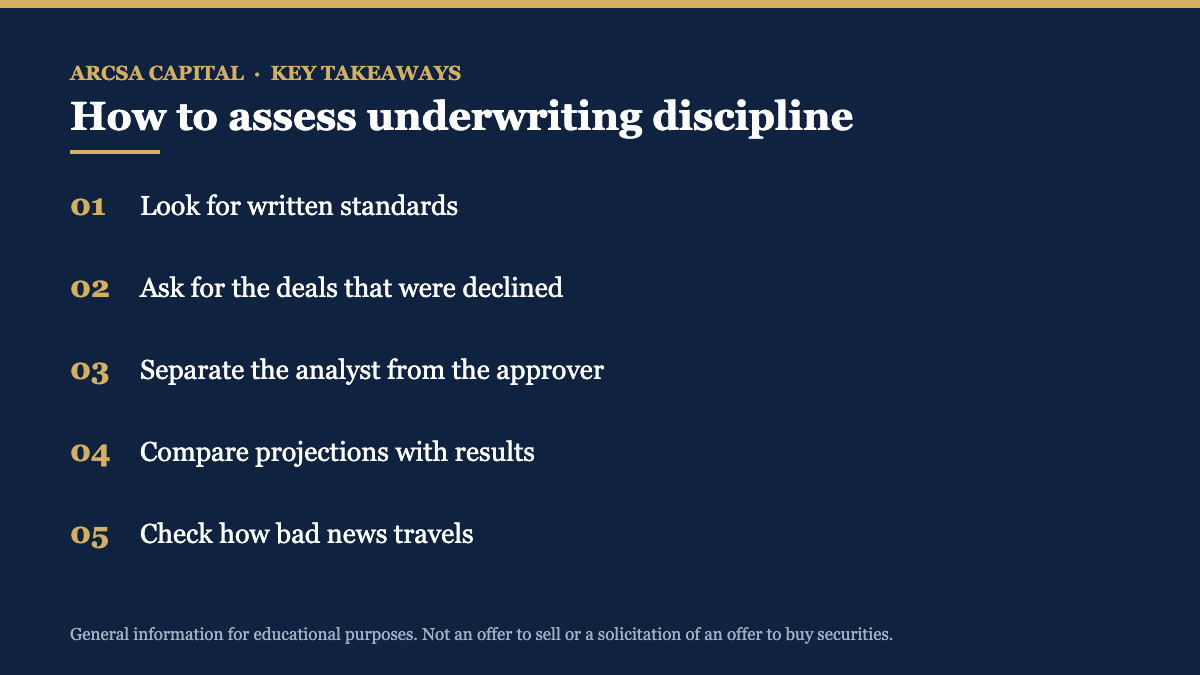
- Look for written standards. A sponsor should be able to show its acquisition criteria, return thresholds and approval steps in writing, dated before the deals they were applied to.
- Ask for the deals that were declined. A pipeline with no rejections suggests that the standards bend. Declined opportunities, with reasons, are the clearest evidence of discipline.
- Separate the analyst from the approver. When the person who sources a deal also approves it, pressure to close wins. Independent review is a structural safeguard.
- Compare projections with results. Deal-by-deal variance between underwritten and realized figures shows whether assumptions are calibrated or habitually optimistic.
- Check how bad news travels. A disciplined organization reports delays and overruns early and adjusts the model. Silence until the exit is a warning sign.
Frequently asked questions about underwriting discipline
What is underwriting discipline in real estate?
It is the consistent application of predefined standards to every acquisition, regardless of how persuasive a particular opportunity appears. It covers how comparables are chosen, how costs and timelines are estimated, what margin of safety is required and who has authority to approve an exception. Discipline is what remains of the process when the market is competitive.
How can an LP assess it before allocating?
Request the investment policy, a sample investment committee memo and the post-closing review of a completed deal. Read them side by side. The memo should reflect the policy, and the review should revisit the memo’s assumptions. Gaps between the three documents are more informative than any presentation.
Which assumptions are most often too optimistic?
Exit prices, time to sell and renovation costs. Each tends to be estimated from the best recent example rather than from the median. A careful model uses conservative comparables, adds time for permits and buyer financing, and carries a contingency that is sized from the sponsor’s own history.
Does a strong track record prove disciplined underwriting?
Not by itself. Good results in a rising market can come from price appreciation rather than from process. What an allocator wants to see is that results were achieved within the assumptions, across different market conditions, and that losses or underperforming deals are disclosed and explained.
What governance features support discipline over time?
An investment committee with documented votes, a conflict-of-interest policy, limits on concentration and leverage, and periodic independent review. None of these removes investment risk, and private real estate can result in loss of capital, but together they make it harder for a single enthusiastic judgment to override the standards.
Important disclosures
Not an offer. This article is for informational and educational purposes only and does not constitute an offer to sell, a solicitation of an offer to buy, or a recommendation of any security. No offer is or will be made except pursuant to definitive subscription documentation delivered to investors whose accredited status has been verified.
Exempt offering; no regulatory approval. Interests in vehicles managed by ARCSA Capital are not registered under the Securities Act of 1933 and are offered in reliance on an exemption under Regulation D. Neither the SEC nor any other federal or state authority has reviewed, endorsed or approved this offering or passed upon its merits; any representation to the contrary is unlawful. ARCSA Capital is not registered as an investment adviser or as a broker-dealer. Participation is limited to accredited investors as defined in Rule 501(a), whose status is verified with documentation before any subscription — self-certification is not sufficient and is not accepted.
Target returns. Any return figure presented is an underwriting objective based on strategy assumptions and market conditions at the date of publication. It is not a promise, not fixed income and not a commitment to distribute. Actual results may differ materially. Past performance, whether of ARCSA Capital or of affiliated entities, is not indicative of future results.
Risk and liquidity. Private real estate investing involves substantial risk, including the total loss of capital: market, execution, liquidity, leverage, valuation, regulatory and tax risk. Interests are illiquid, subject to transfer restrictions, and no secondary market exists or is expected to develop.
Forward-looking statements; no advice. This article may contain forward-looking statements, inherently subject to risks and uncertainties; no assurance is given as to any projection or scenario. Nothing here is investment, legal or tax advice, and reading it creates no advisory or fiduciary relationship. Consult your own advisers before making any investment decision. Full disclosures: Legal Hub.
